




Audit a design before it’s built.
Select a page in Figma and get a scored UX report in minutes, while a fix still costs a few clicks and not a sprint.
Included with Pro and Team. Reads your file, never changes it.
The UX Signal plugin in Figma: a page’s desktop, tablet and phone frames are selected, the plugin lists all three, runs the audit, and shows a score of 78 out of 100.

Measured, not guessed
Contrast and target size come from your layers.
Up to three widths
Desktop, tablet and phone in one audit.
Read-only
It never edits, moves or adds a layer.
Contrast, measured from your layers.
A screenshot can only be judged by eye. A layer has a colour and a box, so the plugin compares each text layer with what is really behind it.
- Held to the WCAG line: 4.5:1, or 3:1 for large text
- Text over a photo is marked as not measurable, never guessed
- Failing pairs are grouped, so one grey is one finding
Surfaces, considered
Stone, terrazzo and porcelain, cut to order for the rooms people remember.
2.3:1 measured. Needs 4.5:1.
#AAAAAA on #FFFFFF, 16px body text
One page, at every width you drew.
Select a page's desktop, tablet and phone frames together. The audit judges how the design adapts, and measures every button and field where a thumb is the pointer.
- Tap targets held to 44px on tablet and phone
- One frame per width; extras are skipped, not guessed at
- Desktop only? Mobile is left out of the score, and the report says so
Desktop 1440px
Message, hierarchy, layout
Tablet 834px
Layout and tap targets
Phone 390px
Tap targets and stacking
Every finding comes with its fix.
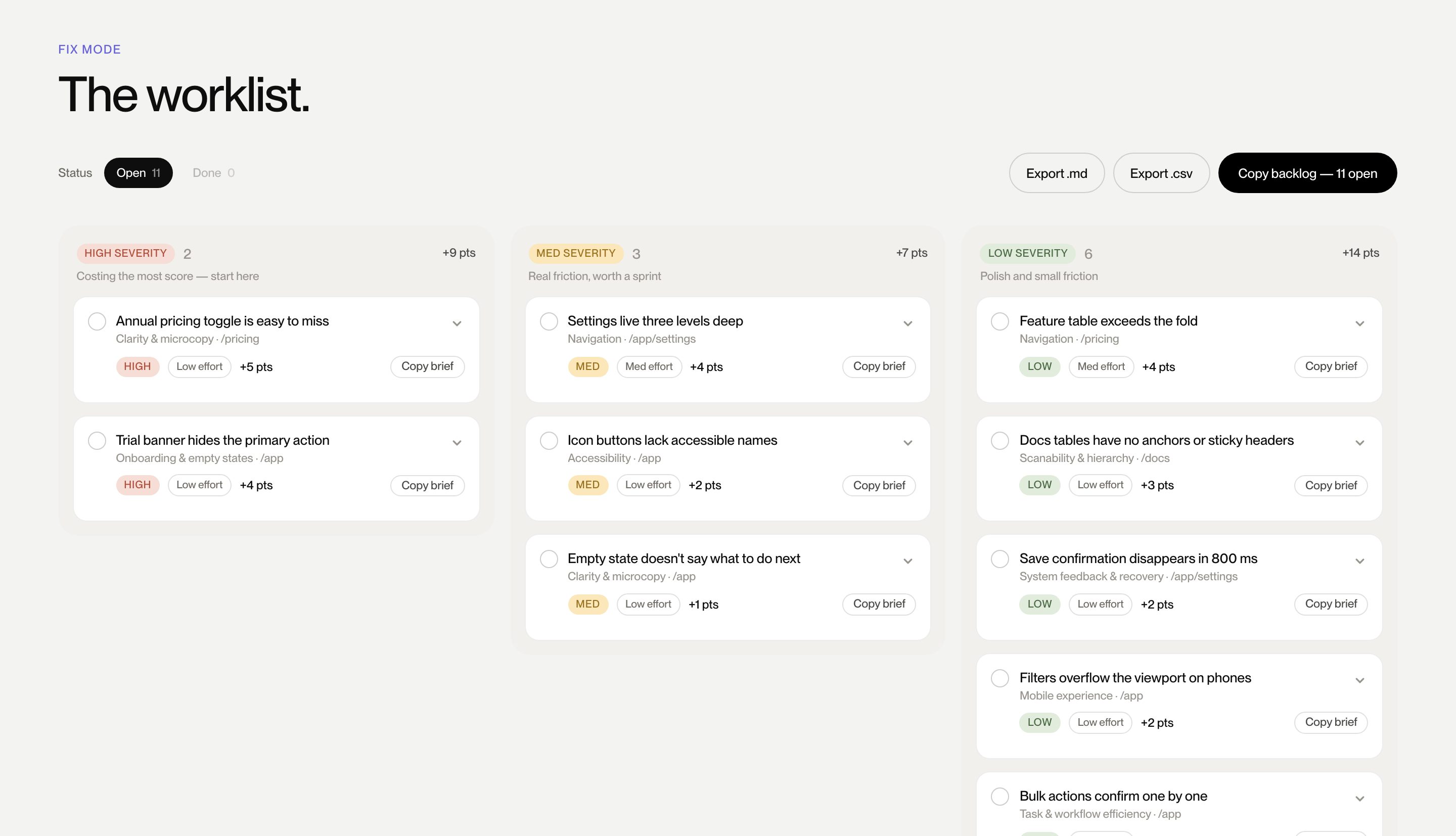
The score comes back in the plugin. The report is on your dashboard: each finding with where it is, why it costs you, and what to change, ready to hand to whoever builds it.
- A worklist you can export or copy into your backlog
- Share it with a client by link, in your own branding on Team
- Audit the same page again and see what moved
Three steps, all inside Figma.
Connect once
Add the plugin from Figma Community and press Connect. Approve the short code on uxsignal.io. No password is typed into Figma.
Select a page
Click its desktop frame. Add the tablet and phone frames and all three widths are audited together.
Read the score
A few minutes later the score is in the plugin, and the full report is on your dashboard.
A design is scored only on what it shows.
Load speed, SEO and code don’t exist until a page is built. They are left out of a design’s score, not counted as passes.
Included with Pro and Team.
No extra seat and no add-on. A design audit counts as one audit.
Before you install it.
No. The plugin reads the frames you select and exports a picture of each. It never edits, moves or adds a layer.
Only what you select, and only when you press Audit: a picture of each frame, plus the text, colours, sizes and layer names read from it. It goes to your UX Signal account and is used to produce your report.
Pro or Team. A design audit counts as one audit, the same as auditing a URL.
Because a design has neither. Those categories are left out of a design's score entirely, so the number reflects only what was judged. Audit the URL once the page is live and you get them.
Not yet. Today it audits one page at up to three widths. Multi-screen flows and clickable prototypes are next.

Find it in the design, not in the build.
In review at Figma Community